
Published on 30 September 2025
What a battery safe does, and what a safety cabinet does not

Lithium‑ion batteries are convenient, but can also be dangerous. A single defective cell in a battery can lead to overheating, smoke or even fire. Yet many companies still store them in a cabinet that was never designed for this purpose. It may seem safe, but often it is not.
A safety cabinet is not the same as a battery safe. In this blog you’ll read what the difference is, and why that difference matters for the safety of your business, your employees and your insurance coverage.
What a safety cabinet fails to do in a battery fire
Many cabinets used for charging or storing lithium‑ion batteries are based on chemical storage cabinets. Think of so‑called EN 14470‑1 cabinets.
These cabinets are designed for flammable liquids, such as paint or solvents. They protect against fire coming from outside the cabinet, but not when the fire erupts inside it. That is exactly the risk with lithium‑ion batteries: the fire usually begins within the battery itself.
What happens when a battery ignites inside a safety cabinet?
- The cabinet cannot withstand the pressure of an exploding battery; the doors may even burst open.
- Toxic smoke gases escape and spread rapidly.
- The exterior becomes glowing hot and can ignite other nearby materials.
- The fire can spread to the rest of your building, causing extensive damage or even risk to life.
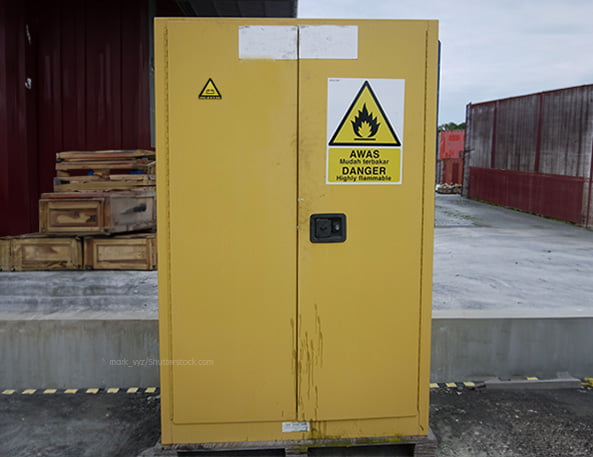
An example of a safety cabinet
What a battery safe does
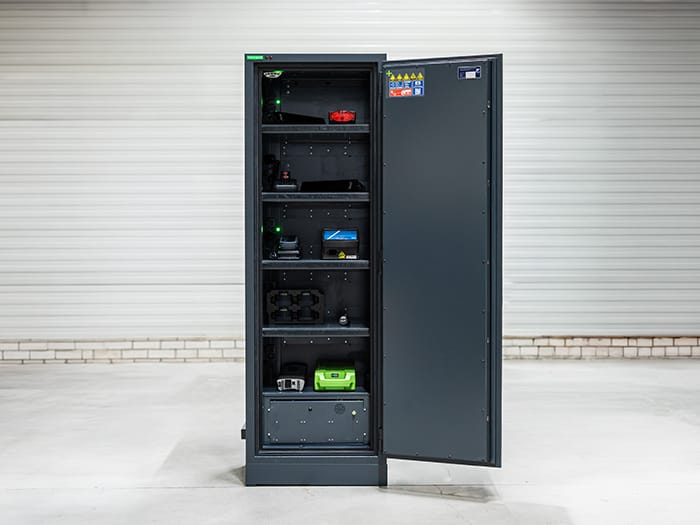
A battery safe — such as those from Batteryguard — is specially engineered to protect its surroundings from a fire originating inside the safe. That makes all the difference.
Our battery safes are based on fire‑resistant safes, not on converted chemical cabinets. They are designed and tested for the specific risks of lithium‑ion batteries.

Unique features of the Batteryguard XL battery safe:
- Protects the surroundings from fires that start inside.
- The doors remain closed, even in the event of an explosion within the safe.
- Toxic smoke gases are either contained or safely vented (if the safe is connected).
- The exterior remains cool, preventing fire spread to the surroundings.
- Tested and certified in accordance with the most recent regulation VDMA 24994 and recognised by insurers.
Also read our blog: Why you should not charge lithium‑ion batteries in a safety cabinet.
Insurers impose ever stricter requirements
More and more insurers scrutinise how you store and charge lithium‑ion batteries. A standard chemical or safety cabinet often no longer suffices.
A certified battery safe offers not only maximum protection, but also greater certainty in case of damage or an insurance claim. You fulfil the requirements, and demonstrate that you take risks seriously. Read how Nationale‑Nederlanden advises on these issues in our blog about lithium‑ion fires.
Safety starts with your responsibility
As an organisation, you carry an important responsibility in this matter. In our blog, you’ll learn how a risk assessment (RI&E) helps you turn that responsibility into concrete and verifiable action.
Go to the blog: What you need to arrange for a safe working environment with lithium-ion batteries
Want to know more?
Would you like to find out which battery safe is suitable for your situation? Please feel free to contact us. We are happy to help you explore your options!
Curious about all the possibilities?
Our safes specialists will be happy to advise you on our Batteryguard battery cabinets.
Also interesting:

30 March 2026
View the new Batteryguard brochure
Are you looking for a battery safe for your organisation? Then...
Read more
26 February 2026
New: compact, certified Batteryguard HE battery safes
Does your organisation work with lithium-ion batteries? Then you know that...
Read more

18 December 2025
Fire above the clouds – When batteries become dangerous
A recent incident on an airplane dramatically illustrates the risks associated...
Read more

23 September 2025
What you need to arrange for a safe working environment with lithium-ion batteries
It seemed like a normal workday, until someone noticed the smell...
Read more
